

Churn rate is an important SaaS metric that shows how many customers a business loses over a specific period. Customer acquisition gets a lot of attention in SaaS, but acquiring new customers is only one part of sustainable growth. If existing customers continue to leave, businesses have to constantly replace lost customers and revenue just to maintain their current position.
For SaaS businesses that depend on recurring subscriptions, churn rate can directly affect monthly recurring revenue (MRR), customer lifetime value, and long-term growth.
But not every customer who churns makes a conscious decision to leave. Sometimes a subscription is lost because a payment fails, a card expires, an invoice remains unpaid, a customer misses a payment reminder, or a business does not follow up at the right time.
These situations create an opportunity for subscription billing software to play a role in customer retention.
With automated billing, payment follow-ups, notifications, and customer communication, ChargeEase helps SaaS businesses manage the billing lifecycle, recover avoidable revenue losses, and create timely touchpoints that can help customers remain active.
In this blog, let’s dive into what churn rate means, why it matters, and how subscription billing software can help businesses manage churn and support sustainable growth.
What Is Churn Rate?
Churn rate is the percentage of customers who are no longer using or paying for a company’s products or services for various reasons.
For a SaaS business, this could mean customers who cancel their subscriptions or whose subscriptions end because they do not renew.
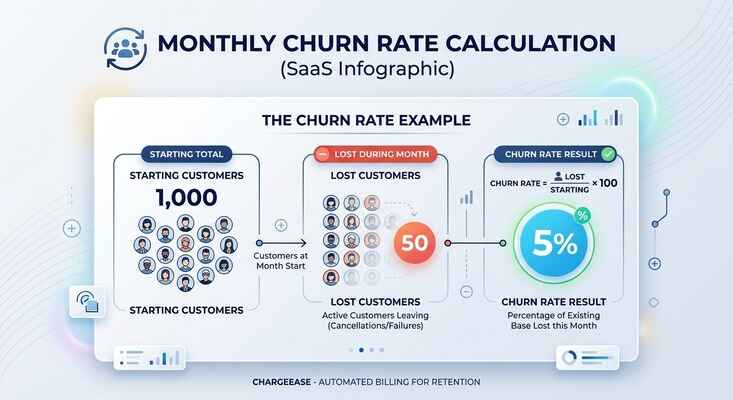
For example, if a SaaS company starts a month with 1,000 customers and 50 customers leave during that month:
50 ÷ 1,000 × 100 = 5%
The company’s monthly customer churn rate is 5%. Churn rate gives businesses a simple way to understand how much of their existing customer base they are losing over time.
However, the number alone does not tell the whole story.
Why Churn Rate Increases
A business also has to understand why clients leave. There may be some drop-off as the customer no longer needs the goods. Others may depart over cost, product experience, customer service or competition. Tracking your customer churn rate is especially critical for SaaS and B2B organisations. These businesses are generally based on recurring subscriptions and long-term client relationships; therefore, customer retention can directly affect revenue stability and long-term success. Churn can also be a valuable indicator of how engaged your customers are, how relevant your product is to them, and how good your customer service and support are.
Regular churn rate analysis helps firms understand where the customer experience is lacking and build focused retention measures to solve these issues. Businesses may reduce customer churn, establish a more satisfied and loyal client base and shift churn from a business problem to an opportunity for long-term success and deeper customer relationships.
What Does Churn Rate Mean for a Business?
Churn tells you how good a business is at keeping its customers. So a higher turnover rate suggests more consumers are leaving in the monitored period. This can put pressure on MRR for a recurring-revenue organisation and make long-term expansion more challenging.
Imagine a SaaS company with 10,000 subscribers.
If 300 customers leave every month, the company needs to continuously acquire new customers to replace those losses.
But consider that some of those 300 customers did not actually intend to leave. Their payments failed, their cards expired, or their invoices remained unpaid because there was no timely follow-up.
Those customers represent a different retention opportunity. This is where billing operations can become part of a SaaS company’s retention strategy.
Why Is Churn Rate Important?
Churn is important because when you lose a customer, you could lose more than a transaction. In a subscription business, a customer who cancels might mean the loss of months, if not years, of potential recurring revenue.
A high turnover rate can impact:
- Monthly recurring revenue
- Annual recurring revenue
- Customer lifetime value
- Revenue predictability
- Customer acquisition efficiency
- Profitability
- Long-term growth
If a business spends a lot of money to get a customer and then quickly loses that customer, it may not have time to recover its cost of acquisition and onboarding, for example.
Therefore, retention is key to sustainable SaaS growth.
Not all churn events are created equal for firms, however.
Voluntary churn is when a client chooses to discontinue using a product.
Involuntary churn happens when a subscription is lost due to payment issues like a failed transaction or an expired payment method.
The second group is where billing automation may really add value.
What Is Customer Churn?
Customer churn is the rate at which customers discontinue the use of a company’s product or service over a given period of time.
For subscription organisations, customer churn is typically due to the consumer cancelling or not renewing a subscription.
The basic calculation for customer attrition is:
Customer Churn Rate = Customers Lost ÷ Customers at the Beginning of the Period × 100
For example:
- Starting customers: 5,000
- Customers lost: 150
150 ÷ 5,000 × 100 = 3%
The customer churn rate is 3%.
But client churn doesn’t tell you how much income was lost. The financial effect of a SaaS company losing 100 small clients will be substantially different than losing 10 corporate customers.
That’s why SaaS companies need to measure both revenue churn and customer churn.
What Is the Difference Between Churn Rate and Retention Rate?
The churn rate is the percentage of customers who leave.
Retention rate is the percentage of consumers that remain.
In simple terms:
Churn = customers lost
Retention = customers retained
If a business experiences a 5% customer churn rate for a given period, its customer retention rate may be in the region of 95%, providing the same customer demographic and methods are used.
These two measures assist companies in understanding how their customers behave. But knowing the retention rate isn’t enough. There’s also a need for businesses to know what’s making
Businesses also need to understand what is causing customers to leave and whether some of those losses can be prevented.
This is where automated customer communication and billing follow-ups can support retention efforts.
How Does Customer Churn Affect Business Growth?
Churn can be a compounded problem for SaaS companies. Let’s say a corporation gains 1,000 new clients, but loses 200 existing customers in the same period. It’s created a big replacement requirement for the company, but it’s created new business.
High turnover can affect growth in a number of ways.
1. Lost recurring revenue
Every customer who leaves can reduce future recurring revenue.
2. Higher pressure on acquisition
It has to get new customers just to make up for the clients it has already lost.
3. Lower customer lifetime value
Customers who leave earlier generate less revenue over their relationship with the company.
4. Less predictable revenue
High customer turnover can make recurring revenue more difficult to forecast.
5. Lost opportunities for expansion
A customer who churns cannot upgrade, purchase additional products, or expand their account.
This is why SaaS companies need to think about retention throughout the entire customer lifecycle—not only when a customer clicks “Cancel.”
What Does a High Churn Rate Indicate?
A high churn rate indicates that a significant percentage of customers are leaving during a specific period.
But it does not automatically tell you why they are leaving.
Businesses should investigate churn by looking at factors such as:
- Customer segment
- Subscription plan
- Customer tenure
- Product usage
- Pricing
- Customer service
- Onboarding
- Payment failures
- Failed renewals
- Unpaid invoices
- Expired payment methods
This analysis can separate customer dissatisfaction from preventable billing-related churn.
For example, if customers are cancelling because the product does not meet their expectations, billing automation cannot solve the underlying problem.
But if customers are being lost because recurring payments fail and there is no effective recovery process, subscription billing automation can help address that part of the problem.
What Is the Formula for Calculating Customer Churn Rate?
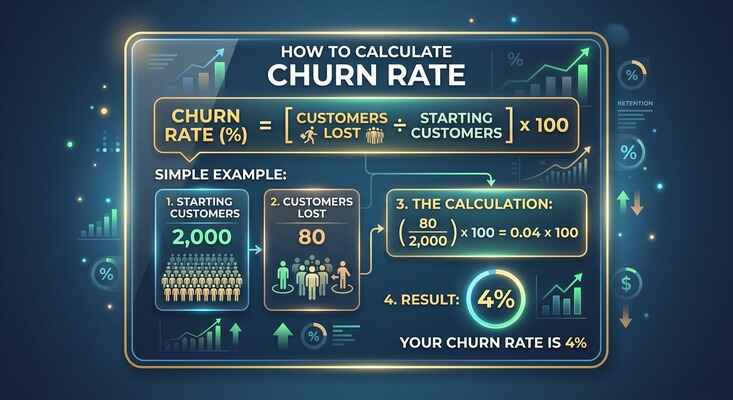
The customer churn formula is:
Customer Churn Rate (%) = Number of Customers Lost ÷ Number of Customers at the Start of the Period × 100
For example, a SaaS business begins the quarter with 10,000 customers and loses 400.
400 ÷ 10,000 × 100 = 4%
The quarterly customer churn rate is 4%.
Tracking this metric over several periods can help businesses determine whether churn is increasing, decreasing, or remaining relatively stable.
How Do You Calculate Monthly Churn Rate?
Monthly churn measures customer losses during a month.
Monthly Churn Rate = Customers Lost During the Month ÷ Customers at the Beginning of the Month × 100
For example:
- Customers at the beginning of the month = 10,000
- Customers lost during the month = 300
300 ÷ 10,000 × 100 = 3%
The monthly churn rate is 3%.
SaaS businesses should look beyond a single month, however. Tracking monthly churn over time can reveal patterns that a single measurement cannot.
For example, an increase in churn after payment failures or billing issues may indicate that the business needs a stronger payment recovery and customer notification process.
How Do You Calculate Annual Churn Rate?
Annual churn measures customer losses over a 12-month period.
The basic formula is:
Annual Churn Rate = Customers Lost During the Year ÷ Customers at the Beginning of the Year × 100
For example:
- Customers at the beginning of the year = 20,000
- Customers lost during the year = 2,000
2,000 ÷ 20,000 × 100 = 10%
The annual churn rate is 10%.
Businesses should distinguish between an actual annual churn calculation and an annualized estimate based on monthly churn, because monthly losses can compound over time.
What Is the Difference Between Customer Churn and Revenue Churn?
Customer churn tells you how many customers you lost.
Revenue churn tells you how much recurring revenue you lost.
For example, suppose a SaaS company has 1,000 customers and loses 50.
Its customer churn is:
50 ÷ 1,000 × 100 = 5%
Now suppose those customers represented $4,000 of the company’s $100,000 starting monthly recurring revenue.
Revenue churn would be:
$4,000 ÷ $100,000 × 100 = 4%
The company therefore experienced:
- 5% customer churn
- 4% revenue churn
The difference matters because customers don’t necessarily have equal contract values.
A company can lose a small number of high-value customers and experience significant revenue churn even when its customer churn percentage appears relatively low.
What Is the Difference Between Gross Churn and Net Churn?
Gross and net churn provide another way to understand revenue loss.
Gross Revenue Churn
Gross revenue churn measures recurring revenue lost through customer cancellations and contractions before considering expansion revenue.
A simplified formula is:
Gross Revenue Churn = Revenue Lost From Churn and Contraction ÷ Starting Recurring Revenue × 100
For example, if a company starts with $100,000 in recurring revenue and loses $8,000:
$8,000 ÷ $100,000 × 100 = 8%
The gross revenue churn is 8%.
Net Revenue Churn
Net revenue churn accounts for expansion revenue generated from existing customers.
A simplified formula is:
Net Revenue Churn = (Revenue Lost − Expansion Revenue) ÷ Starting Recurring Revenue × 100
Suppose the company:
- Starts with $100,000 in recurring revenue
- Loses $8,000
- Generates $3,000 in expansion revenue
The calculation becomes:
($8,000 − $3,000) ÷ $100,000 × 100 = 5%
The net revenue churn is 5%.
This gives businesses a broader view of how existing customers affect recurring revenue.
Should Businesses Measure Customer Churn or Revenue Churn?
For SaaS businesses, measuring both can provide a more complete picture.
Customer churn answers:
“How many customers are we losing?”
Revenue churn answers:
“How much recurring revenue are we losing?”
A business with thousands of small customers may focus heavily on customer churn, while a B2B SaaS company with a smaller number of high-value accounts may need to pay close attention to revenue churn.
Businesses should also segment these metrics to understand where churn is occurring.
But measuring churn is only the first step.
The next question should be:
What can we do to prevent avoidable churn?
How Can Subscription Billing Software Help Reduce Churn?
Not every customer who disappears from a SaaS customer base has decided to leave.
Some customers churn because a payment fails and the issue is never resolved.
Others may forget to update an expired card or overlook an invoice notification.
If the billing system does not follow up, a temporary payment problem can eventually become a permanent subscription cancellation.
This is where subscription billing software such as ChargeEase can become part of a SaaS company’s retention strategy.
ChargeEase can help businesses create a more consistent billing communication process by automating payment-related notifications, follow-ups, and customer reminders.
Instead of relying on a finance or customer support team to manually monitor every failed payment, invoice, or subscription event, businesses can use automated workflows to maintain communication with customers.
1. Recover Failed Payments Before They Become Churn
A failed payment does not necessarily mean a customer wants to cancel.
The payment may have failed because of:
- An expired card
- Insufficient funds
- A temporary payment issue
- Incorrect payment information
- A declined transaction
When customers are notified promptly and given an opportunity to resolve the issue, businesses have a better chance of recovering the payment and keeping the subscription active.
ChargeEase can help SaaS businesses manage these billing events and maintain follow-up communication instead of allowing a failed transaction to immediately become a lost customer.
2. Automate Payment Follow-Ups
Following up with thousands of customers manually is difficult.
Subscription billing software can automate the process.
ChargeEase can help businesses create systematic follow-ups for events such as:
- Failed payments
- Pending payments
- Unpaid invoices
- Upcoming renewals
- Payment reminders
- Subscription-related events
This ensures customers receive relevant communication without requiring the billing team to manually contact every account.
3. Keep Customers Informed Through Notifications
Communication is an important part of subscription management.
Customers need to know when:
- A payment has failed
- An invoice is due
- A subscription is approaching renewal
- Their payment information needs attention
- A billing action is required
Timely notifications can reduce the chance that customers miss important billing events.
With ChargeEase, SaaS businesses can use automated email and notification workflows to maintain consistent communication throughout the subscription lifecycle.
4. Create a Structured Dunning Process
Dunning refers to the process of communicating with customers and attempting to recover payment after a failed transaction.
A structured dunning process can help businesses address payment failures before they result in involuntary churn.
Instead of treating a failed payment as the end of the customer relationship, businesses can establish a sequence of:
Payment failure → notification → follow-up → payment recovery → subscription retention
The exact workflow can be customized according to the business’s billing process.
5. Support Customer Retention Through the Billing Lifecycle
Retention does not begin when a customer clicks the cancellation button.
It happens throughout the customer lifecycle.
A customer interacts with a SaaS company through:
- Subscription
- Trial
- Invoice
- Payment
- Renewal
- Upgrade
- Downgrade
- Cancellation
Each of these events creates an opportunity for relevant communication.
By centralizing subscription and billing workflows, ChargeEase can help businesses maintain those touchpoints and reduce the operational gaps that can contribute to avoidable customer loss.
How ChargeEase Helps SaaS Businesses Manage Churn
ChargeEase can support SaaS businesses by connecting subscription billing with automated customer communication.
Instead of treating billing as simply a process for generating invoices and collecting payments, businesses can use their billing workflows to create timely customer touchpoints.
With ChargeEase, businesses can use billing-related automation to:
Monitor → Notify → Follow Up → Recover → Retain
Monitor
Identify billing events such as failed payments, unpaid invoices, renewals, and other subscription activity.
Notify
Send timely notifications to customers when action is required.
Follow Up
Continue communication when a payment or billing issue remains unresolved.
Recover
Give customers an opportunity to resolve payment problems before the subscription is lost.
Retain
Reduce avoidable subscription interruptions and support a healthier customer base.
This approach does not eliminate every form of churn. Customers may still leave because of pricing, product experience, changing business needs, competition, or other reasons.
But by automating billing follow-ups and payment recovery, SaaS businesses can address the portion of churn that is connected to billing and payment friction.

Turn Billing Into a Customer Retention Opportunity
Churn rate is not simply a metric to report at the end of the month.
It is a signal.
When churn increases, SaaS businesses need to understand whether customers are leaving because they no longer see value in the product—or because the business failed to address a preventable billing issue.
That’s why subscription billing should be viewed as more than an invoicing function.
With ChargeEase, SaaS businesses can automate billing communication, follow up with customers, manage payment-related events, and create structured workflows designed to recover revenue before avoidable payment issues turn into subscription churn.
The result is a more proactive approach to subscription management:
Don’t wait for customers to churn. Build billing workflows that give them a reason—and an opportunity—to stay.
Frequently Asked Questions About Churn Rate
Churn rate is the percentage of customers who stop using or paying for a company's product or service during a specific period.
Customer churn can result from factors such as pricing, poor product experience, changing customer needs, competition, customer service issues, or payment-related problems.
Subscription billing software can help reduce avoidable and involuntary churn by automating payment recovery, reminders, notifications, and follow-ups. It cannot prevent customers from leaving for every possible reason.
A failed payment can cause a subscription to become overdue or eventually inactive if the issue is not resolved. Automated payment retries and customer notifications can give customers an opportunity to update their payment details or complete the payment.
ChargeEase can help SaaS businesses manage subscription billing workflows, automate payment-related notifications and follow-ups, and support payment recovery. These processes can help businesses address billing-related issues before they result in avoidable subscription loss.
Customer churn measures the percentage of customers lost, while revenue churn measures the percentage of recurring revenue lost.
Monitoring churn helps SaaS businesses understand customer retention, recurring revenue losses, and potential growth challenges. Segmenting churn can also help businesses identify where customer losses are occurring and investigate their causes.