
Choosing billing software is really a decision about cash flow. Invoicing is the visible part, but what you are actually buying is fewer days between delivering a service and being paid for it and fewer hours your finance team spends chasing that gap.
If your business bills the same customers month after month, that gap is where the money leaks. A clinic invoicing retainer patients, a property manager collecting rent across three buildings, a school raising term fees, a gym running memberships, a SaaS company on annual plans the pattern is identical. Dozens or hundreds of small, predictable invoices, each of which someone has to remember to raise, send, chase and reconcile.
Most Pakistani businesses still run this on spreadsheets and WhatsApp reminders. It works until it doesn’t. An invoice is missed. A payment lands unreconciled. A customer’s plan changed in March but nobody updated the schedule. By the time anyone notices, the receivable is ninety days old.
This guide sets out what to look for when you replace that process with software and, just as importantly, which requirements are specific to operating in Pakistan and are routinely handled badly by international platforms.
Why global billing platforms often fit Pakistani businesses poorly
The well-known international billing tools are genuinely capable products. They are also built for a different market, and the mismatch shows up in predictable places.
Pricing in dollars. Your subscription cost moves with the exchange rate. A budget set in July can be materially wrong by January, through no decision of your own.
Payment rails. Global platforms are built around card networks and ACH-equivalent transfers. A large share of Pakistani B2C collection happens through mobile wallets and direct bank transfer. If your software can’t record or reconcile those, your “automated” system still ends with someone matching payments by hand.
Tax logic. Sales tax on services in Pakistan is administered provincially, at differing rates, under separate authorities. Federal sales tax on goods sits alongside it. Withholding obligations attach to a wide range of payments. No international platform models this out of the box, and configuring it around their assumptions is expensive.
Compliance timelines. The FBR’s digital invoicing programme has moved quickly and repeatedly. A vendor whose product roadmap is set in another continent will not be tracking Pakistani SROs.
Support hours. When collections break on the 1st of the month, a support queue operating on Pacific time is a real operational cost.
None of this makes global tools bad. It makes them a poor value proposition for a Pakistani SME that simply wants recurring invoices to go out correctly and payments to come in on time.
| International platform | Locally built platform | |
| Subscription pricing | USD, exposed to exchange rate movement | PKR, fixed and budgetable |
| Payment collection | Cards and international transfer | Bank transfer, mobile wallets, cards |
| Sales tax on services | Generic tax engine, manual configuration | Modelled on federal and provincial regimes |
| FBR digital invoicing | Not on the roadmap | Tracked as a product requirement |
| Support | Offshore hours, ticket queues | Local hours, direct contact |
| Contracting | Foreign entity, foreign law | Local entity, local invoicing |
What billing software actually needs to do
The feature lists published by most vendors run to twenty or thirty items, which is a way of avoiding hierarchy. In practice the requirements group into five things. Judge any platform on these.
1. Automation that removes the monthly scramble
This is the core of it, and it has four parts that work as a chain.
Invoice generation. The system raises each invoice against the customer’s own billing cycle — monthly, quarterly, annual, or something custom without anyone initiating it. Nothing is missed because nothing depends on someone remembering.
Recurring schedules. Plans, proration, mid-cycle upgrades and downgrades, pauses and cancellations all need to be handled by the schedule rather than by exception. If changing a customer’s plan means editing next month’s invoice manually, the automation is cosmetic.
Payment reminders. Most late payment in Pakistan is not refusal. It is a forgotten invoice sitting in an inbox. Automated reminders before and after the due date recover a meaningful share of overdues with no staff time at all, and without the relationship cost of a phone call.
Payment recovery. For invoices that go past the reminder stage, the system should run a defined follow-up sequence — escalating notices, a record of contact attempts, and a clear ageing view so that collections becomes a process rather than a scramble.
Ask a vendor to demonstrate this end to end on a live account, not on slides.
2. Collection through the channels your customers actually use
Customers pay faster when they can pay the way they normally pay. In Pakistan that means giving them a choice rather than insisting on one rail.
ChargeEase supports collection through bank transfer, JazzCash, EasyPaisa, and credit and debit cards, with each payment recorded against the originating invoice so reconciliation is not a separate exercise at month end.
3. Visibility you don’t have to wait for
You should not have to wait for a month-end close to know where the business stands. A billing platform holds the data to answer that continuously, and the good ones surface it.
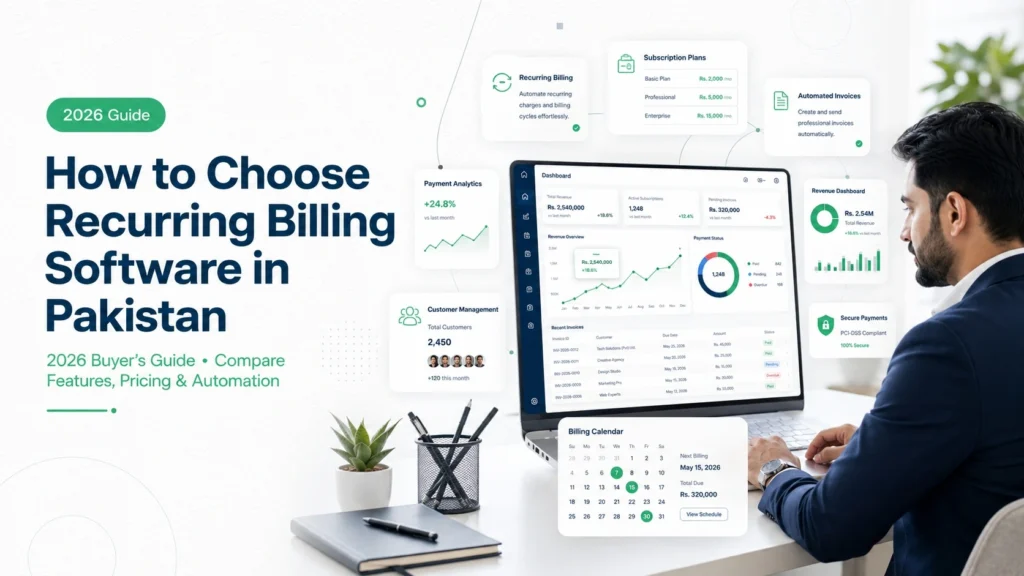
At minimum you want, on one screen: revenue billed and revenue collected, invoices outstanding by ageing bucket, payments received in the period, active subscriptions and their value, and churn or cancellation activity.
Reporting should extend beyond the dashboard into exportable revenue summaries, customer statements, payment histories and collection performance the working papers your accountant will ask for and your auditor will test.
4. Compliance built for the Pakistani regime
This is where the gap between local and international products is widest, and it is the part most worth scrutinising.
Sales tax on services. If you supply services across provinces, you are dealing with separate authorities at differing rates. The system should apply the correct rate by service and jurisdiction, distinguish standard-rated, zero-rated and exempt lines, and produce output that reconciles to the return you actually file.
Invoice content. A tax invoice must carry prescribed particulars supplier and buyer NTN and STRN, a sequential invoice number, description, quantity, value and tax charged. Invoices that omit these create problems for your customer’s input tax claim, which means they create problems for you.
Withholding. Where payments to or from you attract withholding, the system should capture the data your statements require rather than leaving it to be reconstructed from bank narrations at quarter end.
FBR digital invoicing. This is the significant one. Under Rule 150Q of the Sales Tax Rules, 2006 and the notifications issued under it — SRO 709(I)/2025, the revised phased schedule in SRO 1852(I)/2025, and SRO 1413(I)/2025 sales tax registered persons are required to integrate their invoicing systems with the FBR’s computerised system through a licensed integrator or PRAL, and to issue structured electronic invoices. Sales Tax General Order No. 01 of 2026 subsequently permitted the engagement of more than one licensed integrator, and restricted amendment or cancellation of an electronic invoice beyond seventy-two hours of generation without prior approval of the Commissioner Inland Revenue. Draft SRO 288(I)/2026 proposes to extend a comparable framework to a wide range of service businesses under the Income Tax Rules.
The practical consequence for a subscription business is that recurring invoices cannot sit outside this system. An invoice issued outside the integrated channel is not a valid tax invoice, which puts your customer’s input tax adjustment at risk and exposes you to penalty under section 33 of the Sales Tax Act, 1990.
ChargeEase is built with this framework in mind: invoice data is captured and structured so that it can be passed to your licensed integrator or PRAL for transmission, rather than having to be re-keyed from a system that was never designed for Pakistani requirements.
5. Room to grow, and a price you can plan around
Two things determine whether the software you choose now is still the right one in three years.
Scale. More customers, more plans, more branches, more transaction volume — all of it should be absorbed without a migration. Migrating billing data mid-life is expensive and risky, and it is worth paying attention to at the point of selection rather than discovering the ceiling later.
Cost you can forecast. The headline subscription fee is only part of the picture. Currency movement, international transaction charges and per-transaction fees can quietly double the effective cost of a dollar-priced platform. Because ChargeEase is priced in Pakistani Rupees, the number in your budget is the number you pay.
Cloud access and centralised customer management sit alongside these as baseline expectations rather than differentiators. Any serious platform in 2026 lets your finance team work from anywhere and keeps customer profiles, plans, billing history and payment status in one place. Treat their absence as disqualifying rather than their presence as impressive.
Who this applies to
Recurring billing is not a software-industry problem. It applies to any business that raises the same invoice to the same customer on a schedule:
- Clinics, hospitals and diagnostic laboratories billing retainers and packages
- Real estate and property management firms collecting rent, maintenance and service charges
- Schools, colleges and training institutes raising term and monthly fees
- Gyms, fitness studios and members’ clubs
- Professional service firms on retainer arrangements
- Facility management and AMC providers
- SaaS companies and startups on subscription plans
The mechanics are the same in each case. Only the label on the invoice changes.
Questions to put to any vendor
Before signing, get direct answers to these. Vague answers are answers.
- Show me a recurring invoice being generated, sent, reminded on and recovered — on a live account.
- Which payment rails are live today, and which are on the roadmap?
- How does the system handle a mid-cycle plan change with proration?
- How do you apply sales tax on services across provinces?
- What is your position on FBR digital invoicing, and are you a licensed integrator or do you feed one?
- What does a tax invoice generated by your system look like, field by field?
- What are your support hours, and what is the escalation path?
- What is the price in PKR, and what triggers it to change?
- What happens to my data if I leave?
- What is the largest customer base you currently handle?
The decision
Billing software is not a cost centre you tolerate. It is the mechanism that converts work already delivered into cash in the account, and every day it shortens that cycle is working capital you didn’t have to borrow.
For a Pakistani business, the choice comes down to whether you want a globally capable product configured around assumptions that don’t hold here, or a platform built for the regime you actually operate in — priced in rupees, connected to the rails your customers use, and tracking the compliance obligations that apply to you.
ChargeEase was built for the second case.
See it on your own numbers. Book a walkthrough and we’ll run your current billing cycle through the platform, with your plans and your tax treatment, before you commit to anything. [Book a demo →]