
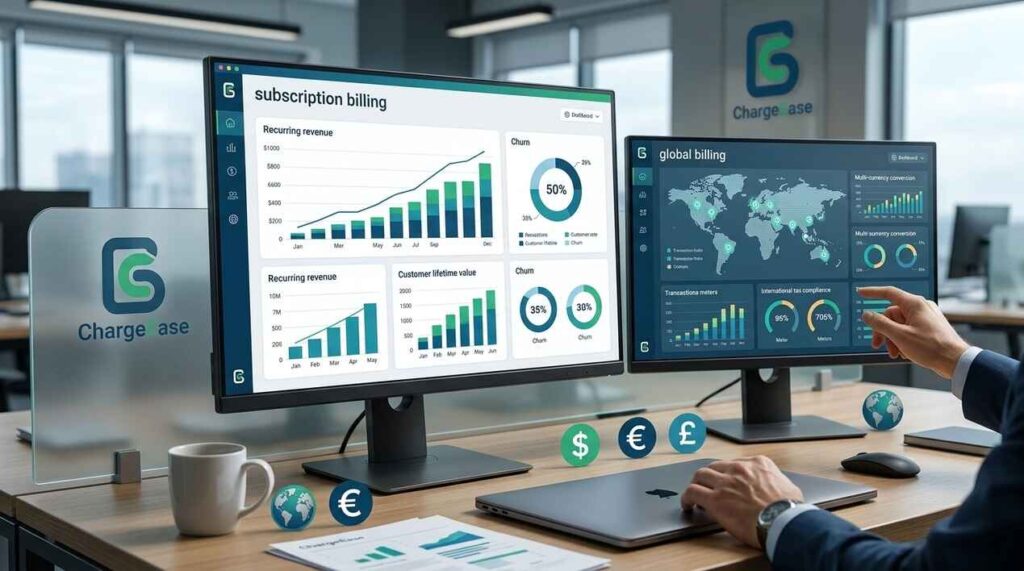
Subscription billing software helps SaaS and B2B businesses automate recurring billing, invoice generation, that leads to payment collection, and revenue tracking. For Pakistani businesses, however, choosing the right subscription billing software is phenomenal. It involves more than comparing features.
Of course, cost-effectiveness is the first priority of every business. The cost of the software, the currency used for pricing, the billing model, payment requirements, and the amount of manual finance work a platform can eliminate can all affect its real value.
Global platforms such as QuickBooks, Zoho Books, Stripe Billing, and Chargebee offer different combinations of accounting, invoicing, subscription management, payment processing, and revenue management. For a Pakistani business, the important question is not simply which platform has the longest feature list. It is whether the platform matches the company’s business model, budget, currency, billing workflow, and reporting requirements.
Why Pakistani Businesses Should Compare Cost, Currency, and Features
Subscription billing software becomes a recurring operating expense, so businesses should look beyond the headline monthly price.
Currency is one of the first factors to consider. QuickBooks’ Pakistan website currently lists its plans in US dollars, including US21forSimpleStart,US31 for Essentials, and US$ 89 for Advanced before promotional discounts. Zoho Books also publishes its public plans in US dollars. Its current pricing includes a free plan and paid plans beginning at $20 per organization per month on its US pricing page.
Stripe Billing uses a usage-based pricing model. Its current pay-as-you-go Billing plan charges 0.7% of Billing volume, while its paid monthly plans begin at $620 per month under a one-year contract.
Chargebee also uses a mix of fixed and usage-based pricing. Its current Flow pricing, for example, shows $99 plus 0.65% of monthly invoicing volume at the displayed pricing tier.
For a Pakistani business that earns and budgets primarily in PKR, foreign-currency software costs can make monthly budgeting less predictable. Exchange-rate fluctuations can affect the effective cost in PKR, while usage-based pricing can increase as the company’s billing volume grows.

That is why businesses should compare:
- Monthly or annual software cost
- Pricing currency
- Usage or transaction-based fees
- Recurring billing functionality
- Invoice generation
- Payment collection
- Payment reminders and follow-ups
- Accounts receivable visibility
- Revenue reporting
- Local payment and tax requirements
- Implementation and operational workload
Why PKR-Based Subscription Billing Software Can Reduce Billing Overheads for Pakistani Businesses
PKR-based subscription billing software can make the software expense easier to budget because the published subscription price is already stated in the business’s operating currency.
ChargeEase currently lists its subscription billing plans in PKR, with its Starter, Growth, and Enterprise plans priced at PKR 20,000, PKR 50,000, and PKR 85,000 per month, respectively. Its plans also include billing, invoicing, reporting, and additional automation capabilities at higher tiers.
But billing overhead is not limited to the price of software.
As a business grows, finance and operations teams may spend significant time creating invoices, checking recurring billing dates, monitoring overdue accounts, sending reminders, following up with customers, reconciling payments, and preparing revenue reports.
Subscription billing software can reduce this manual workload by automating repeatable parts of the billing cycle.
ChargeEase, for example, provides recurring billing, invoice generation, payment collection, reminders, dunning, and financial reporting in a centralized platform.
The business case therefore should not be based only on “Which software has the lowest subscription price?”
A more useful question is:
How much billing work can the platform automate, and what does that save the business in time and operating overhead?
Local Subscription Billing Software vs Global Billing Platforms: A Buyer-Focused Comparison
Not every billing and accounting platform is designed for exactly the same purpose.
QuickBooks and Zoho Books are broader accounting platforms that also support recurring invoicing and other billing workflows. Stripe Billing is focused more specifically on subscription and billing infrastructure. Chargebee provides dedicated subscription billing, invoicing, revenue, and receivables functionality at a global scale.
ChargeEase takes a Pakistan-focused approach to subscription billing and invoicing.
The following comparison helps a buyer understand the difference before looking at individual features.
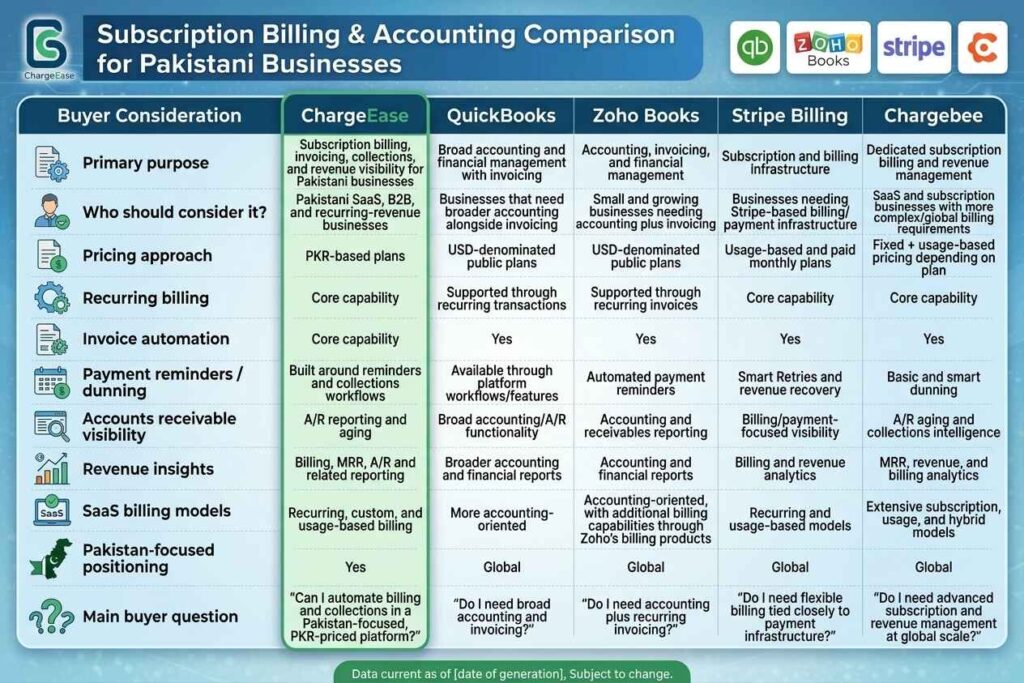
QuickBooks describes its Pakistan offering around accounting, invoicing, expenses, bank feeds, tax tracking, reports, bills and payments, multi-currency, and recurring transactions on eligible plans.
Zoho Books combines accounting and invoicing features with recurring invoices, automated payment reminders, reconciliation, reporting, and other financial workflows.
Stripe Billing provides subscription management, recurring billing, invoicing, and revenue-recovery capabilities, with pricing based on Billing volume or contracted monthly tiers.
Chargebee provides subscription management, recurring and usage-based billing, invoicing, dunning, A/R aging, MRR calculations, revenue analytics, and multi-currency capabilities.
Why Pricing Currency Matters for Pakistani Businesses
A common mistake when selecting subscription billing software is comparing the listed price without considering the currency in which that price is charged.
For a Pakistani company, a USD-denominated subscription has to be converted into PKR for budgeting and financial planning. The effective PKR cost can therefore change as currency exchange rates move.
A PKR-priced platform provides a more straightforward reference point for a business whose internal budgets are maintained in rupees.
There is another important distinction: the currency of the software subscription is not necessarily the same as the currency in which the platform allows a business to bill its customers.
For example, Chargebee supports multiple currencies, so global billing platforms may be perfectly capable of handling customers outside Pakistan.
The real comparison for a Pakistani business is therefore about the complete cost structure:
What does the software cost?
What currency is the subscription priced in?
Are there billing-volume or transaction fees?
What payment-processing costs apply?
How will the total cost change as the business grows?
How Subscription Billing Software Reduces Manual Billing Work
Manual billing becomes increasingly difficult as a business acquires more recurring customers.
A finance team may have to:
- Create invoices according to individual customer schedules
- Track monthly, quarterly, or annual billing cycles
- Monitor unpaid invoices
- Send payment reminders
- Follow up on overdue accounts
- Track failed payments
- Reconcile collections
- Prepare revenue reports
Subscription billing software centralizes these workflows.
ChargeEase supports recurring billing and invoice generation based on billing schedules, including monthly, quarterly, annual, and custom cycles. It also supports one-time, consolidated, and usage-based invoicing. (ChargeEase)
For SaaS and B2B companies with recurring customers, this can reduce the amount of repetitive billing work that finance and operations teams need to perform manually.
How Subscription Billing Software Helps Manage Accounts Receivable
Accounts receivable becomes increasingly important as a company grows.
Knowing that an invoice was generated is not enough. The finance team also needs to know:
- What has been paid?
- What is overdue?
- Which customers need follow-up?
- How old are the outstanding invoices?
- How much revenue remains uncollected?
ChargeEase provides reporting around accounts receivable and A/R aging, alongside payment reminders and dunning workflows. (ChargeEase)
This gives finance teams a more centralized view of outstanding payments and collection activity.
The same principle applies to global subscription platforms. Chargebee, for example, currently highlights A/R aging, automated A/R workflows, dunning, smart retry logic, and collections intelligence as part of its billing and revenue capabilities.
The difference for a Pakistani business may therefore be less about whether these capabilities exist and more about which platform provides the required capabilities at an appropriate cost, currency, complexity level, and level of local relevance.
How Subscription Billing Software Gives Businesses Better Revenue Insights
Billing software can provide much more information than a list of invoices.
Recurring-revenue businesses also need visibility into:
Monthly recurring revenue (MRR)
Outstanding accounts receivable
A/R aging
Overdue invoices
Payment activity
Churn
Revenue trends
Billing performance
ChargeEase currently highlights MRR, A/R aging, cash flow, churn, taxes, and related revenue analytics as part of its reporting capabilities.
This can help business owners and finance teams answer practical questions about their recurring revenue and collections without relying on multiple spreadsheets or disconnected billing records.
Subscription Billing Software for SaaS and B2B Businesses
SaaS and B2B companies frequently have more complex billing requirements than businesses that issue only one-time invoices.
A SaaS company might bill customers monthly or annually. A B2B company may use contract billing, custom pricing, multiple users, usage-based charges, upgrades, add-ons, or negotiated rates.
ChargeEase supports recurring billing, usage-based billing, custom billing models, and subscription lifecycle events such as upgrades, downgrades, renewals, cancellations, and trials.
Global platforms can also support sophisticated pricing models. Stripe Billing supports subscriptions and usage-based billing, while Chargebee supports flat-fee, tiered, volume, usage, seat-based, and hybrid pricing models.
For this reason, SaaS and B2B businesses should evaluate not just whether a platform supports subscriptions, but how well it supports the company’s specific pricing model and billing process.
Is Global Billing Software Always More Expensive for Pakistani Businesses?
Not necessarily.
Global platforms offer different products, pricing structures, integrations, and levels of functionality, so it would be inaccurate to say that every global platform will cost more for every Pakistani business.
The more useful question is whether the total cost matches the value and requirements of the business.
For example, QuickBooks has a broader accounting focus and publishes its Pakistan plans in USD.
Zoho Books also provides broad accounting functionality and publishes public plans in USD.
Stripe Billing prices its pay-as-you-go Billing product at 0.7% of Billing volume, with additional contracted monthly plans.
Chargebee combines fixed and usage-based pricing and provides advanced subscription and revenue capabilities.
A Pakistani business should therefore calculate the cost in PKR and consider how the pricing model will behave as customer numbers and billing volume increase.
Why Pakistani Businesses May Consider Local Subscription Billing Software
A Pakistan-focused subscription billing platform can address a different set of priorities from a global accounting or billing product.
For some businesses, the relevant advantages may include:
- Pricing in PKR
- Billing workflows designed around recurring revenue
- Local payment considerations
- Automated invoicing
- Payment reminders
- Accounts receivable visibility
- Revenue reporting
- Localized support
- Lower administrative workload
ChargeEase positions itself specifically for Pakistani B2B and SaaS businesses and combines recurring billing, invoicing, payment collection, reminders, revenue reporting, and tax and compliance capabilities. (ChargeEase)
That local focus can be particularly relevant for small and growing businesses that want to automate billing without introducing unnecessary financial or operational complexity.
What Should Pakistani Businesses Look for in Subscription Billing Software?
Before choosing a subscription billing platform, businesses should evaluate the entire billing lifecycle.
Recurring Billing
Can the platform automatically bill customers on monthly, quarterly, annual, or custom schedules?
Invoice Generation
Can invoices be generated automatically according to each customer’s billing terms?
Payment Collection
Does the platform support the payment methods and payment workflows your customers actually use?
Payment Follow-Ups
Can reminders and dunning workflows reduce manual collection activity?
Accounts Receivable
Can the finance team quickly identify outstanding invoices and A/R aging?
Revenue Reporting
Can management track recurring revenue, MRR, outstanding payments, and other relevant financial indicators?
Pricing
Is the subscription model predictable and suitable for the business’s budget?
Currency
Is the software priced in a way that fits the company’s primary operating currency?
Scalability
Can the platform support increasing customer numbers, more billing models, and higher billing volume?
Why Choose ChargeEase for Subscription Billing in Pakistan?
ChargeEase is positioned as a subscription billing and invoicing platform for Pakistani B2B and SaaS businesses.
Its current plans are published in PKR, beginning at PKR 20,000 per month, with higher plans adding capabilities such as dunning and churn recovery, real-time revenue analytics, tax and compliance automation, custom integrations, and additional support. (ChargeEase)
The platform also supports recurring and one-time invoicing, custom billing schedules, consolidated invoices, usage-based billing, subscription lifecycle management, payment follow-ups, MRR reporting, and A/R aging.
For Pakistani SaaS and B2B businesses, the decision should therefore go beyond comparing feature counts.
The more useful evaluation is based on cost, currency, billing automation, payment workflows, receivables visibility, revenue reporting, and the amount of manual work the platform can remove.