
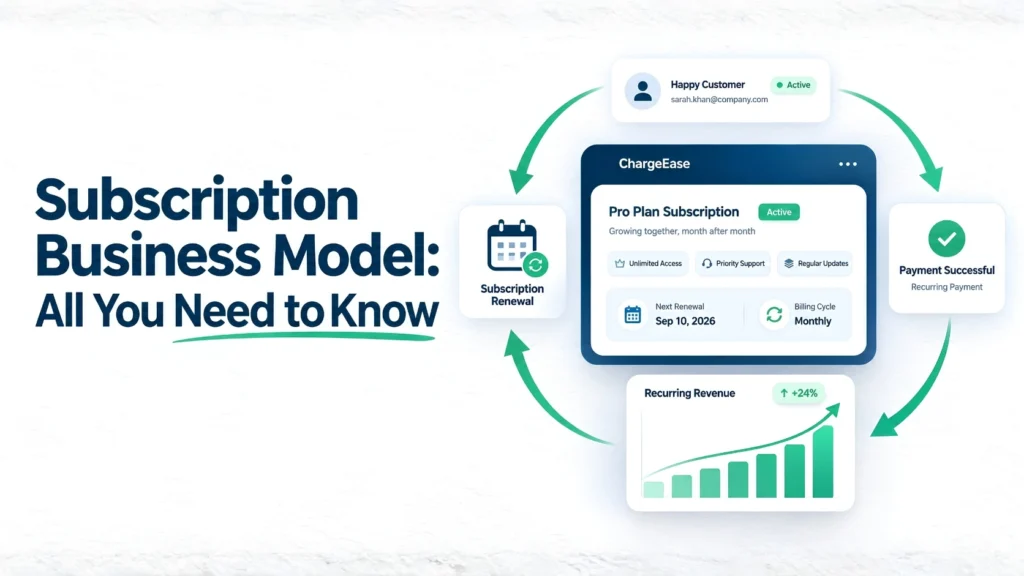
Every second business out of 100 is now offering subscription services for the products or services they sell. Recent research shows the subscription market has increased over the past decade by more than 430%. One of the biggest advantages of subscription models is that customers can get their favourite games, shop for their favourite skin care products and many other items and services without leaving their home.
Subscription billing software allows firms to better track revenue, cash flow and working capital. Subscribers will also be able to get updated products and services at the same time. This makes subscription model a comfortable option for businesses as well as customers.
The subscription business model is here to stay, so is subscription billing. In this article, you will learn about the merits and cons of the subscription business model and why subscription billing software is gaining pace as the future of e-commerce and other enterprises.
How does a subscription business model work?
A subscription business model is a technique of selling items or services that charges clients a recurring cost on a month-to-month, quarter-to-quarter, or year-to-year basis. These payments are handled automatically by a subscription billing system so clients can continue to use the service or get products for as long as the subscription is current.
It differs from one-time shopping in that subscription billing is based on repeat transactions. The major goal is to develop long-term connections with clients while giving them continual access to products, services, or the newest updates.
Key Features of a Subscription Business Model
All subscription businesses have similar characteristics whether it is e-commerce, SaaS, entertainment etc.
Customer Acquisition
Subscription businesses should be transparent about the subscription plans, policies, and terms to customers. Customers must agree to these conditions prior to beginning a subscription. Some companies also provide free trials so clients can try out their products or services before paying.
Recurring Payments
Recurring payments are the heart of the subscription business model. Customers pay on a periodic basis to use a product or service. Depending on the plan, payments can be made monthly, quarterly, or annually.
Recurring Billing
Subscription businesses employ automated subscription billing software to invoice clients at predetermined intervals. Tools such as Chargebee can help businesses with recurring payments, invoicing, taxes, payment reminders, and customer notifications.
Subscription Account Management
Customers can manage their subscriptions through a customer portal. Members can utilise these portals to upgrade/downgrade their plans, renew/cancel their memberships as needed.
Product Delivery
Subscription businesses need to deliver the promised products or services on time, whether these be tangible or digital products. Reliable delivery also keeps the consumer happy and trusting you.
Products or services may be provided daily, weekly, monthly, quarterly or annually depending on the business.
Pricing Options
Most subscription businesses have several levels of price plans that give different levels of access and features. Each plan may have certain limitations based on consumption, features, or level of service provided.
Clients can choose the plan that suits their needs, and businesses can offer several price options to meet the needs of different clients.
Subscription Business Model Categories
Subscription services have become part of many families’ daily lives. In the US, adults spend more than $100 a month on subscriptions, while in Pakistan, households spend $5-$10 a month on subscription-based services.
There are various categories of subscription business models, such as:
Membership Subscription
This model provides clients with ongoing access to certain products, services, or benefits for a recurring price. Examples include gym subscriptions, health care services, real estate businesses.
Members could also be offered specific benefits such as luxury apartments, facilities, internet clubs, or community groups. These services and advantages are normally offered only to members.
Software as a Service (SaaS)
With SaaS, consumers don’t have to buy or create the software themselves. They instead pay a recurring fee to access the software and its features.
The service provider provides software maintenance, upgrades, security, and new features. ChargeEase provides subscription and recurring billing solutions to businesses in Pakistan. It provides a ready-to-use application and dashboard for businesses to handle invoices, track revenue, generate financial reports, and obtain insights on cash flow and working capital.
Platform as a Service (PaaS)
Some businesses also use the Platform as a Service model. It provides the infrastructure and development environment enterprises need to create, test, and deploy their own apps.
ChargeEase may also serve organisations that require infrastructure, storage, scaling, and API usage for their applications. It helps companies to design and deploy their own software without having to build all the infrastructure underneath it themselves.
Content Subscription
Pay for access to digital content. This concept is used by many people to access their favourite films, TV series, music, news and other digital content.
Netflix and Spotify are instances of this, where the consumer pays a recurring fee to have access to a massive library of content.
Usage-Based Subscription
Usage-based subscriptions charge clients based on the level of consumption of a product or service. This concept is widespread among cloud services where clients can be billed according to their utilisation of storage or other resources.
It is also utilised by AI platforms and language models, where the price may depend on usage, such as the amount of data or processing performed.
E-commerce Subscription Boxes
Many e-commerce businesses provide subscription boxes that deliver selected products to clients on a regular basis. These boxes can include food, clothing, beauty products, personal care items and other products.
The major purpose of this model is to personalise the consumer experience. Usually, customers can select products by their preference, wants, lifestyle or fitness objectives and receive them on a recurrent basis.
Advantages of Using Subscription Models for Businesses
The subscription business model keeps clients by providing ease and constant access to products and services. Therefore, subscription-based firms can outperform enterprises that rely on a one-time purchase exclusively.
In the one-time payment model, a business only earns a customer’s revenue once. But with a subscription model, a business can earn income over the customer’s monthly cycle.
Modern businesses, especially SaaS companies, have a more reliable means to get paid by way of monthly recurring revenue. Subscription billing software like ChargeEase may help organisations automate regular payments, increase customer satisfaction, and develop long-term customer connections.
Real estate enterprises, building companies, healthcare organisations, medical billing companies, and educational institutions are some of the many businesses in Pakistan that can use a subscription model to help in collecting payments on time. It also provides the ease of buying products and services from the comfort of one’s home.
Subscription Connects Best With Customers
Subscription models, consequently, assist companies to create deeper client relationships by offering them continued access to digital or physical products and services.
Higher consumer satisfaction with a subscription increases the likelihood of extended engagement with the subscription. They may also suggest the product or service to friends, family or coworkers. Word-of-mouth referrals can assist organisations in gaining new clients and enhancing sales.
Subscription Business Model Easy to Access Customers
The subscription business model gives customers convenience, flexibility and value. Subscription allows users to effortlessly budget and plan their recurrent spending. If they can’t afford it for a while, they can freeze or cancel their subscription.
The subscription models also allow clients to get items or services at a reduced price based on the package they choose. Fixed prices is another big plus. Customers know exactly how much they are paying each time, which creates a better experience for them overall and helps them with their budget.
Instead of making a large investment to own something permanently, customers can pay for access for a specific period. Rental properties and property management services are common examples of this type of subscription model.
Subscription Business Model Is Beneficial for Businesses
The benefits are multiplied when you combine a subscription business model with subscription billing software such as ChargeEase. The program enables firms to manage recurring revenue and have better visibility into their finances.
Recurring billing software can be used by organisations to forecast income, predict demand, manage inventories and automate invoice creation. ChargeEase also allows businesses in Pakistan to bill clients in PKR instead of USD, and manage invoicing as per local tax laws.
Accurate financial reports assist businesses in making better-informed decisions.
Subscription Business Model Offers Tiered Pricing
Subscription businesses often use a tiered pricing strategy, allowing customers to choose a plan based on their budget and needs. Each plan has a fixed recurring price and offers a specific level of access or features.
Some businesses also use usage-based pricing, where customers pay only for the services they use. For example, internet and fiber providers in Pakistan may offer monthly data limits and charge additional fees when users exceed their allotted high-speed data.
Ride-hailing apps such as inDrive and Careem also follow a usage-based model. The fare is usually calculated based on factors such as distance traveled in kilometers and trip duration in minutes.
Subscription billing software can help businesses manage both fixed recurring payments and usage-based billing while reducing the need for manual customization.
Subscription Business Model Works Across Industries
The subscription business model can work for many types of businesses, whether they sell physical products, digital products, or services.
Some businesses believe subscription models cannot work for their industry and prefer one-time sales. However, many businesses have successfully adopted subscription-based revenue models and, in some cases, have completely shifted away from one-time purchases.
Even businesses selling products such as clothing can develop successful subscription models when they offer the right value to customers. The key is to find the right combination of positioning, pricing, and value that fits the target market.
The subscription model is not only about changing customer preferences. It can also provide significant financial benefits to businesses by improving customer retention and giving them more predictable revenue and cash flow.
How to Track Business Performance Using a Subscription Business Model?
Tracking business performance becomes easier when your subscription business has the right billing and subscription management system in place. ChargeEase helps businesses automate recurring billing, manage subscriptions, generate invoices, monitor payments, and access real-time financial insights. These capabilities give businesses greater visibility into revenue, customer activity, cash flow, and subscription performance.
Monthly Recurring Revenue (MRR)
Monthly recurring revenue (MRR) shows the predictable revenue a business expects to generate from active subscriptions each month. ChargeEase simplifies recurring billing by automating invoice generation, payment collection, and payment reminders.
With real-time revenue analytics, businesses can monitor recurring revenue more efficiently, identify payment issues, and gain a clearer view of their financial performance.
Average Revenue Per User (ARPU)
Average revenue per user (ARPU) helps businesses understand how much revenue they generate from each subscriber. By managing subscription plans, pricing, and customer activity through ChargeEase, businesses can gain better visibility into customer revenue and subscription performance.
Its real-time analytics can also help businesses evaluate revenue trends and make informed decisions about pricing and subscription plans.
Voluntary Churn Rate
Voluntary churn occurs when customers intentionally cancel their subscriptions. Tracking this metric helps businesses understand how many customers are leaving and identify opportunities to improve their offerings and customer experience.
ChargeEase helps businesses track the customer lifecycle, manage subscription plans, and monitor upgrades and downgrades. These insights can help businesses identify changes in customer behavior and make better retention decisions.
Involuntary Churn Rate
Involuntary churn occurs when a subscription ends because of payment-related issues rather than a customer’s decision to cancel. Failed payments, expired payment methods, or other billing problems can contribute to involuntary churn.
ChargeEase helps businesses reduce the impact of failed payments through automated payment retries and dunning. Businesses can also use payment notifications and billing insights to identify payment issues and follow up with customers more efficiently.
Churn MRR
Churn MRR represents the recurring revenue lost when customers cancel their subscriptions. Monitoring revenue trends alongside subscription and customer lifecycle data can help businesses understand the financial impact of customer losses.
ChargeEase provides real-time analytics and subscription management capabilities that give businesses greater visibility into revenue performance, customer activity, and subscription changes.
Customer Retention Rate
Customer retention rate measures how effectively a business keeps its subscribers over a specific period. Strong retention generally contributes to more predictable recurring revenue and sustainable growth.
With ChargeEase, businesses can manage the customer lifecycle, monitor subscription activity, and manage plan upgrades and downgrades from one platform. This makes it easier to understand subscription behavior and identify opportunities to improve customer retention.
Trial Conversion Rate
The trial conversion rate measures how many users move from a free trial to a paid subscription. For businesses that offer trial-based plans, monitoring this metric can help determine how effectively trials contribute to recurring revenue.
ChargeEase’s subscription management capabilities allow businesses to manage plans, pricing, and customer lifecycle activity. Combined with real-time analytics, these insights can help businesses evaluate subscription performance and make better decisions about their pricing and plans.
Automated Payment Notifications
Following up on missed payments manually can consume valuable time for billing and finance teams. ChargeEase helps automate payment reminders and notifications, making it easier to communicate with customers about upcoming or failed payments.
Payment retries and dunning also help businesses manage failed recurring payments more efficiently, potentially reducing payment delays and improving cash flow.
Accounts Receivable and Accounts Payable
Keeping track of incoming and outgoing payments is essential for maintaining healthy cash flow. ChargeEase’s invoicing, payment management, and real-time analytics capabilities can give businesses better visibility into their billing activity and financial performance.
By reducing manual billing tasks and providing real-time financial insights, ChargeEase helps businesses monitor their cash flow, identify payment issues, and make more informed financial decisions.
Make Better Decisions With Real-Time Business Insights
A subscription business needs more than automated billing. It needs clear visibility into revenue, subscriptions, payments, and customer activity.
ChargeEase brings these functions together through recurring billing automation,customer lifecycle tracking, and real-time analytics.
How to Implement a Subscription Business Model?
A subscription business model does not work the same way for every business or industry. Before implementing one, you need to understand your business requirements, customers, pricing, and payment needs.
SaaS companies can benefit from subscription models, but they can also work well for real estate, healthcare, educational institutions, gyms, membership clubs, and other businesses. Here are some important factors to consider before implementing a subscription business model.
Local Currency and Payment Methods
Choosing a subscription management software for a subscription-based business that supports local currency and payment methods is important for Pakistani businesses.
ChargeEase is designed for businesses in Pakistan and allows them to manage subscription payments in Pakistani Rupees (PKR) instead of relying on dollar-based billing. This can help businesses avoid unnecessary currency conversion costs and make subscription management easier.
Scalable Solutions
Your subscription model should be able to grow with your business. ChargeEase provides flexible subscription and pricing options that can support different business requirements as they grow.
Businesses can manage different pricing tiers and subscription plans while adapting their billing processes as their customer base expands.
Local Customer Support
Local customer support can make subscription management easier for Pakistani businesses. Language barriers and time zone differences can make it difficult to get timely assistance from international software providers.
ChargeEase provides local customer support to help businesses resolve billing and subscription-related issues when they need assistance.
Advanced Analytics and Financial Insights
Subscription management is not only about collecting recurring payments. Businesses also need accurate data to understand their financial performance.
ChargeEase provides analytics and financial insights that help businesses monitor subscribers, accounts receivable, accounts payable, revenue, and other important financial information.
Businesses can generate monthly and yearly financial reports to understand their performance and make better decisions.
Automate Your Billing Operations
Automation is an important part of implementing a subscription business model. Automating invoice generation, payment processing, and customer notifications can reduce manual work and speed up financial operations.
The right subscription management software can help businesses save time, reduce billing errors, and allow their finance teams to focus on more important tasks.
Keep Customers Engaged and Loyal
A successful subscription model is not only about acquiring customers. Businesses also need to keep subscribers engaged and encourage them to stay longer.
ChargeEase provides flexibility in managing subscription plans and recurring payments, helping businesses create a smoother experience for their customers.
Consider Your Budget
Before choosing a recurring billing software, compare the available options based on your business size, industry, customer base, and budget.
Businesses should also consider customer acquisition cost (CAC) and customer lifetime value (CLV). ChargeEase is designed to provide an affordable subscription management solution for businesses in Pakistan, including real estate companies, educational institutions, healthcare providers, gyms, and membership-based businesses.
Test and Learn
Before fully implementing a subscription model, test it with a small group of customers. This can help you understand whether your pricing, plans, payment process, and overall subscription experience are working as expected.
ChargeEase offers a free trial that allows businesses to test its subscription management features before making a long-term decision.
Prepare for Market Changes
Markets, customer expectations, and business requirements can change over time. With a scalable subscription management system like ChargeEase, businesses can adjust their plans, pricing, and billing processes as their needs evolve.
Follow Regulatory Requirements
ChargeEase helps businesses manage invoices and payments according to applicable Pakistani tax and regulatory requirements. Businesses should also ensure that customer and payment data is handled according to relevant data protection requirements.
Choose the Right Subscription Model
Choosing a subscription business model is not a one-time decision. It requires businesses to continuously balance customer needs, pricing, costs, and business goals.
The right subscription model, combined with reliable subscription management software, can help businesses improve customer satisfaction, manage recurring revenue, and adapt to changing industry trends.
When businesses choose the right model and technology, they can create a more stable foundation for long-term growth and build stronger relationships with their customers.