

Revenue does not become useful to a business simply because it has been earned. A company also needs to know how much revenue it has earned, how much has been collected, what is still outstanding, and when that money is expected to come in.
This is why accrued income becomes important. Accrued income is revenue a business has already earned during a specific accounting period but has not yet received in cash. Depending on the stage of the billing process, these amounts may be reflected as accrued revenue or accounts receivable on the balance sheet. They represent money that the business has a right to receive in the future.
For B2B and SaaS companies, managing this asset can become particularly complex. Customers may pay monthly, quarterly, or annually. Some may make partial payments, while others may have outstanding invoices, failed payments, or different billing arrangements. Without a system to monitor these transactions, it becomes difficult to know exactly how much revenue is collectible at any given time.
Revenue accrual is therefore more than a figure on a financial statement. It provides an important view of a company’s financial position and supports the revenue recognition principle, allowing businesses to recognize revenue when it is earned rather than only when payment is received.
But recognizing accrued income accurately is only the beginning. Businesses also need a reliable process for tracking outstanding amounts, verifying payments, reconciling balances, and following up with customers at the right time.
That is where financial visibility and billing management become essential. With the right system, businesses can see what has been earned, what has been collected, what remains receivable, and where follow-up is needed—giving management a clearer picture of cash flow and overall financial health.
What Is the Accrued Income Process and How Does It Impact Financial Operations?
The revenue accrual process is a fundamental part of accrual accounting. It ensures that a business records revenue when it is earned, rather than waiting until the customer actually makes the payment.
When a transaction has been completed and the business has fulfilled its obligation to the customer, the revenue has been earned—even if the cash has not yet been received. Recording it at this stage gives businesses a more accurate view of their financial performance and aligns with the revenue recognition principle.
This distinction is particularly important for B2B and SaaS companies, where customers may be billed monthly, quarterly, or annually. A business may have already earned revenue while the corresponding payment is still pending or scheduled for a later date.
How Does Revenue Accrual Impact Financial Operations?
It has a direct impact on a company’s financial statements, working capital, cash-flow visibility, and financial decision-making. To maintain accurate records, businesses need to continuously update their systems to get a better idea of their income.
Without an effective billing and subscription management system, this process can become difficult to manage. Finance teams may have to manually match earned revenue with invoices, payments, expenses, and outstanding balances. This becomes even more challenging when customers have different billing cycles or make partial payments.
For SaaS and B2B businesses, having accurate visibility into earned revenue, accrued income, accounts receivable, and outstanding payments is essential.
A subscription billing and financial management platform such as ChargeEase can help businesses maintain this visibility by bringing billing and financial information into one system. Businesses can track revenue as it is earned, monitor receivables, verify incoming payments, identify outstanding balances, and generate financial insights that support better decision-making.
Ultimately, an effective revenue accrual system does more than improve accounting accuracy. It helps businesses understand how much revenue they have earned, how much they have collected, what remains receivable, and how those amounts affect working capital and cash flow.
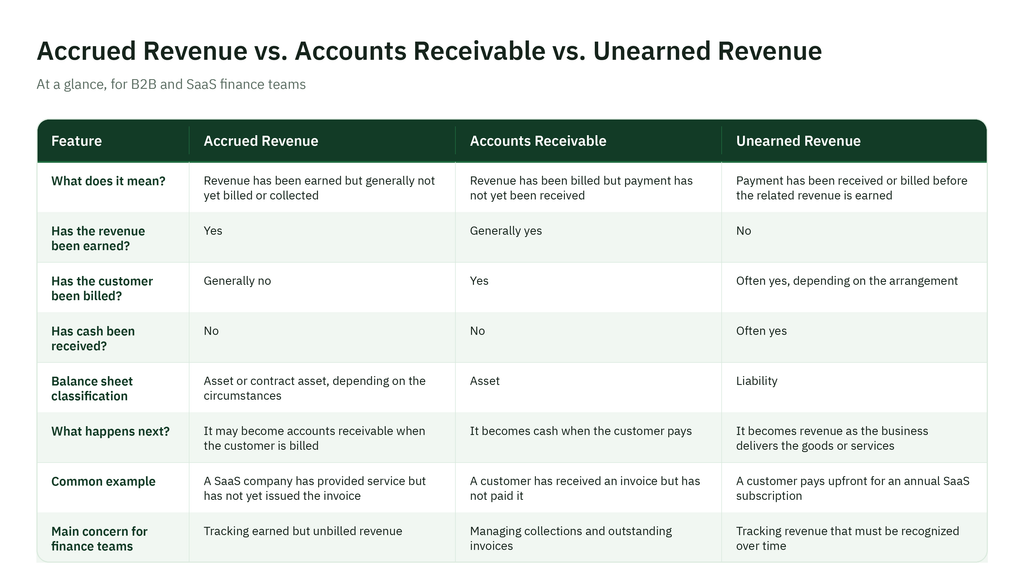
Accrued Revenue vs. Accounts Receivable
Accrued revenue refers to revenue a business has earned but has not yet invoiced or collected. The business has already provided the goods or services, so it has a right to receive payment, even though the invoice may not have been generated yet.
Accounts receivable, on the other hand, generally arises once the business has issued an invoice to the customer and payment is still outstanding.
For example, a SaaS company may provide a service during a billing period but issue the invoice at a later date. Until the invoice is generated, the earned amount may be treated as accrued revenue. Once the invoice is issued, the amount can move into accounts receivable.
This distinction matters because finance teams need to know not only how much revenue has been earned but also how much has been formally billed and remains collectible.
For SaaS and B2B companies, subscription billing software can make this process easier by tracking subscription terms, billing schedules, invoices, payments, and outstanding balances in one place.
Accrued Revenue vs. Unearned Revenue
Accrued revenue and unearned revenue represent almost opposite situations.
Accrued revenue is earned before payment is received, while unearned revenue is received before the business has fully earned the revenue.
Unearned revenue, also called deferred revenue, is common in subscription-based businesses. A customer may pay for a SaaS subscription upfront for three months, six months, or an entire year. Although the business has received the cash, it has not yet delivered the full period of service.
Therefore, the amount received in advance is initially recorded as a liability, rather than immediately being recognized as revenue. As the company delivers the contracted service over the subscription period, the corresponding portion of the deferred revenue is recognized as earned revenue.
For example, if a customer pays for a 12-month SaaS subscription upfront, the entire payment is not necessarily recognized as revenue on the day it is received. Instead, revenue is recognized over the period in which the service is provided, based on the applicable revenue recognition rules.
This is where effective subscription billing and financial reporting become valuable. A business needs visibility into which subscription plan a customer has selected, how much they have paid, what period the payment covers, how much revenue has been earned, and what amount remains deferred or outstanding.
For finance teams managing hundreds or thousands of subscriptions, monitoring these details manually can quickly become complicated. A platform such as ChargeEase can provide greater visibility into subscription billing, payments, receivables, and financial reporting, helping businesses understand what has been collected, what remains outstanding, and how subscription revenue is progressing through the billing cycle.
Ultimately, distinguishing between accrued revenue, accounts receivable, and unearned revenue gives businesses a clearer picture of their financial position. It helps finance teams maintain accurate records, monitor cash flow, follow up on outstanding payments, and make better financial decisions based on when revenue is actually earned rather than simply when cash changes hands.
How Is Accrued Income Classified as a Current Asset In Subscription Billing Software?
Accrued income is classified as a current asset because it represents revenue that a business has already earned but has not yet received in cash. It reflects the company’s legal or economic right to receive payment in the future.
For B2B and SaaS businesses, this distinction becomes particularly important when subscription terms, billing schedules, and payment dates do not occur at the same time. A customer may have an active quarterly or annual subscription, for example, while revenue is recognized over the period in which the service is delivered.
Subscription billing and financial management software can help businesses track these transactions and maintain accurate financial records. Platforms such as ChargeEase can provide reporting and visibility into revenue, billing activity, payments, and outstanding balances, helping finance teams understand what has been earned, what has been collected, and what remains receivable.
From an accounting perspective, when revenue has been earned but has not yet been billed or collected, the accrued revenue account may be debited, while the corresponding revenue account is credited. This allows the business to recognize revenue in the accounting period in which it is earned, in accordance with the applicable revenue recognition principles.
Once the amount is invoiced, it generally moves from accrued revenue into accounts receivable, depending on the company’s accounting process. Accounts receivable represents amounts that have already been billed to customers but are still awaiting payment.
This distinction is particularly useful for subscription-based businesses. Consider a customer who signs up for an annual SaaS plan and pays upfront, while the company’s billing or invoicing process operates on a monthly schedule. The financial system needs to distinguish between the amount already received, the revenue earned during the current period, the amount that remains to be recognized, and any outstanding customer balance.
By maintaining these records systematically, subscription billing software can help businesses produce more accurate financial reports and gain a clearer view of their current assets, revenue, receivables, and cash-flow position.
Ultimately, accurate classification of accrued income gives management a more complete picture of the company’s financial health. Instead of relying only on cash received, decision-makers can see what the business has earned, what it is still entitled to receive, and how its revenue is progressing through the billing cycle. This financial visibility can support better forecasting.
Common Scenarios of Accrued Revenue in Business
Accrued revenue can occur whenever a business has earned revenue by delivering a product or service, but has not yet received payment or issued an invoice. It is common across industries, although the way revenue is recognized can vary depending on the nature of the contract and applicable accounting standards.
Here are some common examples.
1. Consultancy Services
Consulting businesses can often generate accrued revenue when services are delivered over a period of time but billing takes place later.
Consider a study abroad visa consultancy that works with a student for several months. The consultant may help the student with university selection, application preparation, document review, and visa submission. If the agreed service has been completed in December but the consultant does not issue the invoice until a later date, the revenue that has been earned may be recognized as accrued revenue, subject to the terms of the engagement and applicable revenue recognition rules.
This allows the financial statements to reflect the economic activity that has actually taken place during the relevant accounting period rather than waiting until the invoice or cash payment occurs.
2. Subscription-Based and SaaS Businesses
Accrued revenue can also arise in SaaS and subscription-based businesses, particularly when the timing of service delivery, invoicing, and payment does not align.
For example, a SaaS company may provide services throughout December while the customer is billed or invoiced at a later date. The portion of revenue attributable to the service already delivered can be recognized as earned revenue, even though the corresponding payment has not yet been received.
Subscription billing software such as ChargeEase can help businesses track subscription periods, billing schedules, invoices, payments, and revenue-related information, giving finance teams greater visibility into what has been earned and what remains outstanding.
The underlying principle is straightforward: revenue is generally recognized when it is earned, not simply when cash is received.
3. Construction and Long-Term Projects
Construction companies frequently deal with long-term contracts that can extend over several months or even years. Rather than waiting until an entire project is completed, revenue may be recognized progressively as contractual performance obligations or project milestones are satisfied, depending on the applicable accounting method.
For example, if a construction company completes an agreed stage of a project during the second quarter but will not receive payment until a later date, the revenue associated with the completed work may be recognized during the period in which it was earned.
This gives stakeholders a more accurate view of the company’s progress and financial performance during the project.
4. Interest Income
Accrued revenue is also common in the financial sector, particularly with interest income.
For example, a bank may earn interest on a loan during August, while the borrower is scheduled to make the corresponding payment at a later date. Because the interest has been earned during August, it may be recognized as accrued interest income rather than waiting until the cash is received.
This allows the bank’s financial statements to reflect the income generated during the appropriate accounting period.
Why These Examples Matter
Across consulting, SaaS, construction, and financial services, the underlying concept is the same: the timing of earning revenue can be different from the timing of receiving payment.
Accurately tracking this difference helps businesses produce more reliable financial statements, understand their current assets and receivables, and make decisions based on the revenue they have actually earned—not simply the cash that has reached their bank account.
How to Adjust an Accrued Revenue Entry
In accounting, adjusting accrued revenue is an important step in ensuring that a company’s financial statements accurately reflect its financial position and performance. The adjustment allows businesses to recognize revenue that has been earned but not yet received or invoiced, in accordance with the principles of accrual accounting.
Accurate revenue recognition gives businesses a clearer understanding of their financial performance. When management knows how much revenue has been earned during a specific accounting period, it can make more informed decisions about cash flow, forecasting, budgeting, and future growth.
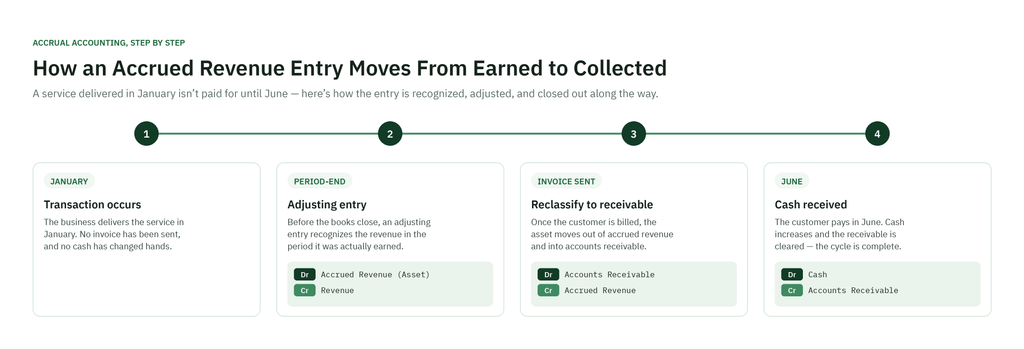
The Accrued Revenue Adjustment Process
The basic accounting entry for recognizing accrued revenue involves debiting the accrued revenue account and crediting the appropriate revenue account.
This records the revenue in the period in which it is earned, even though the related payment may be received at a later date. When the customer is subsequently invoiced or the payment is received, the accrued amount can then be adjusted according to the company’s accounting process.
For example, consider a study abroad consultancy that provides services to a client in June but does not issue the invoice until January. If the revenue was earned in June based on the services delivered and the applicable contract terms, the business may need to recognize that earned amount in June rather than waiting until January.
This approach helps ensure that financial statements represent the company’s economic activity in the appropriate accounting period.
Automating Revenue Recognition With ChargeEase
Managing accrued revenue manually can become increasingly difficult as a business grows. B2B and SaaS companies may have hundreds or thousands of customers with different subscription plans, billing cycles, payment schedules, and revenue recognition requirements.
This is one of the challenges that ChargeEase is designed to address.
ChargeEase combines subscription billing and revenue management capabilities to help businesses streamline financial processes and gain greater visibility into their revenue performance. Instead of relying on disconnected spreadsheets and manual calculations, businesses can automate key aspects of revenue recognition and maintain more consistent financial records.
ChargeEase supports multiple revenue recognition approaches, including straight-line, milestone-based, and usage-based recognition, giving businesses the flexibility to apply a method that aligns with their business model and contractual arrangements.
With automated revenue recognition and financial reporting, businesses can more easily track what revenue has been earned, what remains outstanding, and how revenue is progressing across accounting periods.
The result is greater control over revenue recognition and better visibility for financial decision-making.
Take control of your revenue recognition with ChargeEase. Let your billing and revenue processes work in the background while you focus on the decisions and activities that matter most to your business and your customers.